| History In
the weeks this web site was started, in August 2003,
the town of Kleinschmalkalden celebrated its 625th anniversary.
As far as we know now, the Giegengack family stems from
this charming little town in the hills of the beautiful
Thüringerwald (Thuringia), the green heart of Germany.
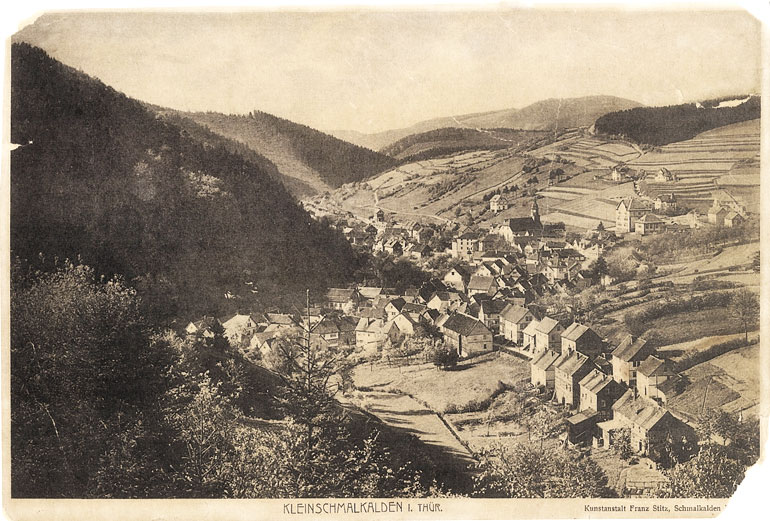
This beautiful postcard of Kleinschmalkalden was sent by Linda Bray (USA). It was her grandmother's, "so it's at least as old as the 1920's", Linda writes. Text on the card: Kleinschmalkalden i. Thür. (in Thuringia), Kunstanstalt Franz Stitz, Schmalkalden ... .
For more then 470 years the history of the Giegengack family
is linked to Kleinschmalkalden. From here our adventurous
ancestors found there way to countries like Denmark,
the Netherlands, the United States of America, Australia etc. At
this page we will have a closer look on the history
of our family members in Thüringen and abroad.
The Giegengack Timeline
Thüringen till 1600
| |
 |
| |
|
Before Christ
The history of Thuringia dates back to the prehistory.
Many evidence of Stone Age people is found in the area.
The oldest finds date back to 350.000 before Christ.
In the first millennium BC Celts
entered the territory now known as Germany and pushed
away the hunters and cowherds that lived there. They
settled in large parts of the present Germany, including
Thuringia. From those times the first sanctuaries in
Thuringia date.
Scandinavian Germanic tribes gradually migrated from
the north and drove away the Celts or mixed with them.
From the beginning of the Christian era the Romans
tried to conquer the Germanic tribes but only a small
portion of southwestern Germany came under their control.
Kingdom of Thuringia
The Kingdom of Thuringia arose approximately at the
beginning of our era. Around Christ’s
Birth the Germanic tribe of the Hermunduren entered
the area and formed their own tribal federation. Apart
from the oldnative and the Celts their neighbours were
tribe members from various Germanic tribes. During the
great Wandering of the Nations the Thuringians remarkably
stayed on in their residential areas. By 500
they had established a large kingdom stretching from
the Harz mountains to the Danube. Little is known concerning
the first kings of Thuringia. The last two kings were
Byssinus and his son Hermenefried. In the year 531
the kingdom went down due to the conquest by the Franks
and the Saxons. The realm was divided into two parts,
remained however an administrative unit. The part at
the north of the Harz mountains went to the Saxons,
the larger Southern part to the Franks. (About the name
Thuringia: click
here.)
Under Frankish
rule
After the fall of the Thuringian kingdom (531) Franks,
Saxons and Swabes immigrated in the area. The Thuringian
tribe remained largely as it was but their territory
was reduced to the Harz mountains and the Thuringian
Forest region and was governed by Frankish dukes (Merovingian
dynasty).
From the sixth century Slavs,
mainly Sorbs, settled down in the deserted area between
Elbe-Saale and the Oder rivers. Occasionally they penetrated
in the east of Thuringia to beyond the Saale. Due to
rivalry amongst themselves the Slavish tribes didn’t
manage to built a lasting administration.
Since the conversion of their king Clovis (496) the
Franks gradually embraced Christianity. The initially
merely loose connection of the Thuringians to the Frankish
realm became gradually firmer. After the conversion
of the Thuringians to Christianity (particularly lead
by St Boniface, who founded a bishopric at Erfurt in
742) Thuringia was the starting point
of the Christianizing up to the Saale and Elbe rivers.
In 751 the Carolingians
took power from the Merovingians. About 800
Charles the Great (Charlemagne) subjected the Saxons
and made Thuringia a march (frontier country) against
the Slavs. In 843 the Frankish empire
was divided in three kingdoms in the Treaty
of Verdun: West, Middle and Eastern Francia.
Eastern Francia, including Thuringia, came under rule
of Louis the German.
A small stem duchy emerged from the fragmentation of
the Frankish Empire.
The Giegengack family in Thuringia
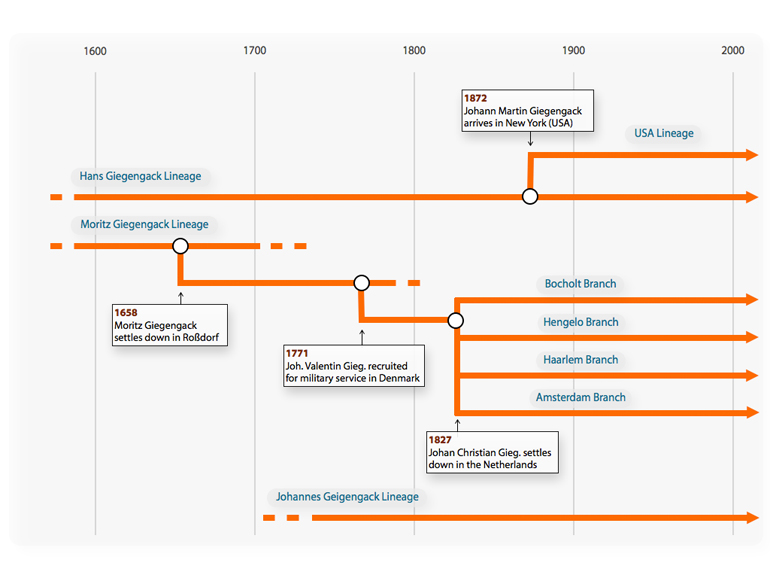
The name Gi(e)gengack first appears in Thuringia in the records of conscript soldiers in 1543. We can savely say that our family lived in Kleinschmalkalden and Thüringen since the late Middle Ages and possibly longer.
To Denmark
Members of the Giegengack family lived in Denmark for
a period of almost a hundred years. Both Valentin Giegengack
and Johannes (or Jochum) Giegengack came from Sachsen-Meiningen
(Thüringen) and moved to Denmark, where they started
families who's members lived in Denmark between about
1771 and 1868. We try to give a small overview of this
episode of the family history.
Johann Valentin
Giegengack, a tailor (like his father) and coming from Roßdorf, Thüringen,
was a soldier in the German city of Zerbst (close to
Magdeburg, Sachsen-Anhalt). In 1771 he was in Oldenburg
(Northern Germany but from 1667 to 1773 under Danish
government) recruited by a certain sergeant Pedersen
for military service in Denmark. He became a Sergeant
in the 'Norske Livregiment'. We think that he went to
Denmark in that same year but the first proof of his
stay in Denmark is from a church book which mentions
his marriage nine years later, on 7 January 1780 in
København (Copenhagen) to Marie Eleonora BISER.
They had six children. One of their children: Johan Christian Giegengack,
is the forefather of all the Dutch branches and the Bocholt
branch. Valentin Giegengack died in Copenhagen in the
Fredriks Hospital on 4 February 1798. Johan
Christian left Denmark between 1826 and 1828 and settled
down in the Netherlands.
Why did Johann Valentin Giegengack leave Thüringen
and joined the Danish military
service? Michael Bregnsbo, associate professor, Ph.D.
at the Odense University explains: 'The Danish army
of that time was a professional one. It was recruited
by hired and paid soldiers instead of conscripts. The
professional soldiers were often recruited abroad, especially
in Germany. Here, recruiting agents of various kings
and princes competed in recruiting soldiers so your
forefathers have probably got the best offer from the
recruiting agent of the king of Denmark. Often former
soldiers were allowed to work in Danish cities and sometimes
they were even allowed to work besides their military
service. Maybe that this has been the case for your
ancestors.'
Also Johannes
Giegengack came from Sachsen-Meiningen (Thüringen), more specific from the town of Rossdorf (see the Moritz Giegengack Lineage). He and his children
lived at the Danish island Lolland in the places Nakskov,
Sandby, Maribo and Vaabensted. His son Henrik Kristian
became a tambour (drummer) in the 'Falsterske Infanterie-Regiment'
in Aalborg (the main city in the Northern Denmark).
The youngest son went to Vordingborg (Südseeland)
where he worked as a dyer [Färber].
Than there is a third Gigengack, also on Lolland: Jorgen
Gigengack. We have no information about his parents
so far. But it seems reasonable that Jorgen Gigengack
is a son of Valentin or Johannes Giegengack.
All three Giegengacks mentioned here have kids, and
some of the daughters married to Danish men. Thanks
to an e-mail that we received on Jan. 6th 2004 from
Johnny Johansen from Nakskov, Denmark, a descendant
of Jorgen Gigengack, we know that there still are descendants
in Denmark nowadays!
Johan Christian Giegengack, the son of Valentin Giegengack,
left Denmark in about 1826 or 1827 and went to the
Netherlands. Again the economical situation could be
the reason for his move. Probably because he married
a catholic woman (Maria Wilhelmina MENTING), all Dutch and Bocholt-Gigengacks - as
far as we know - became Roman Catholic in stead of Protestant.
Johan Christian was a musician/pedlar [Spielmann
- speelman, muzikant,
marskramer]. He settled down in Aalten in the
Netherlands close to the German border, and later went
to Zutphen (also the Netherlands). His descendants moved
to Bocholt, Hengelo, Haarlem and Amsterdam where family
members still live nowadays.
In 1868 Mare Kirstine Gigengack died in Hellenes, Branderslev,
Maribo, and although that brought an end to the Giegengack-dynasty
in the Danish region, her descendants still live in
Denmark.
The earliest generation
To be continued.
To the USA
To be continued.
To the Netherlands
To be continued.
The Kermis-branch
| |
 |
|
|
| |
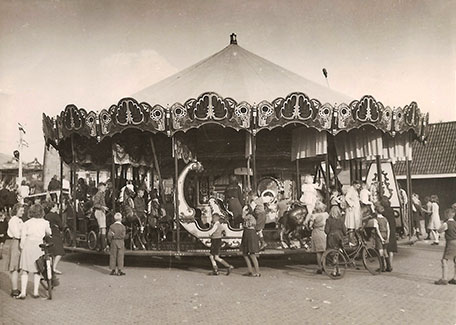
The Gigengack carousel in Hengelo. Year unknown. Photo Fikkert Hengelo. |
| |
|
Kermis is a Dutch language term derived from 'kerk' (church) and 'mis' (mass), originally denoting the mass said on the anniversary of the foundation of a church (or the parish) and in honour of the patron. Such celebrations were regularly held in the Low Countries, in Central Europe and also in northern France, and were accompanied by feasting, dancing and sports of all kinds. (Wikipedia)
About 25 years after his parents had settled down in the Netherlands around 1826, Fredrich Ferdinand Gigengack bought a small carousel in the Dutch town of Aalten, with which he traveled to festivals and fairs. His father Johan Christian already worked as a musician and pedlar, so the family was experienced in the art of traveling and amusing people.
In 1895 Johannes Ferdinand and his wife Johanna Maria TELDERS built a carousel that is still owned by the Gigengack family.
The mill passed to their son Francis Anicetus (born in Zutphen in 1888).
 |
|
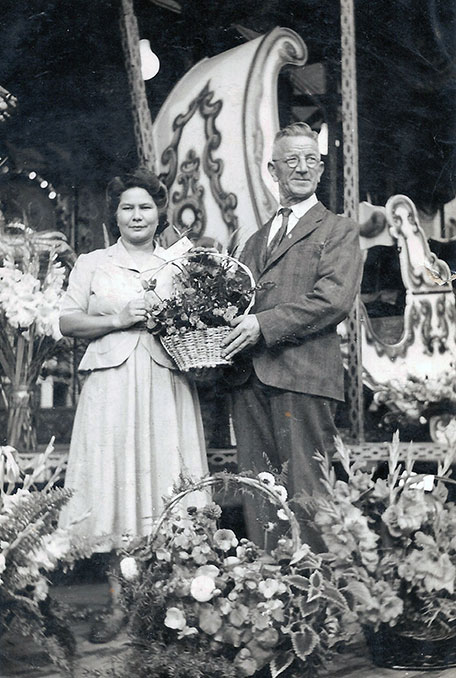
Wijhe, 1949:
Frans and Mien Gigengack are being honoured for the fact that the Gigengack family did visit the town of Wijhe with the carousel for the 75th year. |
| |
|
| |
 |
|
|
| |
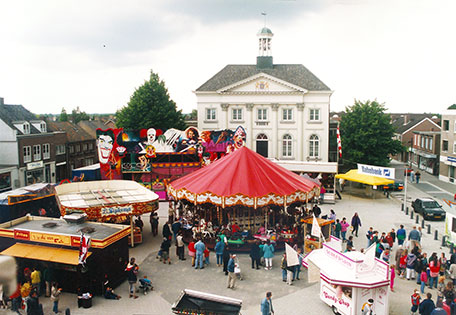
The Gigengack carousel in the town of Zundert (the Netherlands). Year unknown. |
On September 5, 1974 the Gigengack family with their merry-go-round for the hundredth time visited the village of Wijhe, and this time they brought with them a bronze sculpture of the mill, made by sculptor Jan Kip, which was presented to the city council. The late Johan Gigengack wrote in the Twente Post in 1974: "Standing on the floor of the carousel, which was built traditionally on the church square, the mayor in his official address pointed to the 100-year bond between the town of Wijhe and the Gigengack family from Hengelo".
In 1964 oldest son Tonnie Gigengack took over the carousel and continued the work of his ancestors till 2012. Tonnie died in August 2016 and till then no successor found in the family to continue travelling with this carousel.
To be continued.
|